Thursday, October 6, 2011

Madama Butterfly: A Journey From Paris


Giacomo Puccini's Madame Butterfly emerged slowly from her cocoon to become one of the world's most beloved operas.
Despite many twists and turns, 123 years since the story was first told it is the most performed opera in the United States, according to Opera America.
The butterfly story debuted as a novel by Julian Viaud, a former French sailor who had visited Japan. He used the nom de plume Pierre Loti.
To get it performed at the Opéra Comique in Paris Puccini was forced to make significant changes in the libretto and music. Even Carmen, a French opera, had to make substantial changes to accommodate the bourgeois taste of Paris, said opera artistic director Roger Cantrell.
Great composers, including Mozart, were often pragmatic.
The resulting version, the fourth, was translated from French into Italian and has become the version most performed now, according to Julian Budden in Puccini: His Life and Works. It has been cut from three acts to two because of union costs. Puccini preferred two acts, according to Cantrel, whose mentor was taught by Cleofonte Campanili, the conducter of the first two Butterfly performances.
One reason the Paris version became the standard is the publisher withdrew the rights to use the earlier versions, although they were later released.
This summer, in the intimate surroundings of the Central City Opera, the story heard so many times seemed fresh. The display of the American flag on the stage is compelling and helps explain why, in 1989,Butterfly inspired a retelling, Miss Saigon.
Nagasaki is another stark reminder of American power. On July 16, 1945, it was hit by an a nuclear bomb dropped by a U.S. Army Air Force B-29 in a successful bid to force the Japanese to surrender, not unlike like Perry's state-of-the-art Paixhans shells forced Japan to agree to trade in 1853.
Chad Shelton, who played the insensitive Pinkerton, performed so well that it seemed the audience, no doubt familiar with many opera villains, seemed to want to hold back on applauding him. Yunah Lee, who played Butterfly, Cio-Cio San, got a standing ovation.
The earlier versions, in fact, displayed too much of the Ugly American for the director of the Opera Comique, Albert Carré. His wife, soprano Marguerite Carré, was to sing the role of Butterfly.
It was the Victorian Age, Europeans and Americans traveled widely, often to places before seen by Westerners. Gunboat diplomacy opened the door in some cases, including Japan, where U.S. Commodore Matthew Perry fired on the port of Uraga, near present-day Tokyo, to force the opening of trade with America.
Japan later became a popular destination as "Japonisme" was in vogue. The country's art and culture captured imaginations.
Viaud wrote a novel in 1887, Madame Chrysantheme.
His story has a much happier ending than the Butterfly people know today, and it is at the expense of the French sailor he writes about. He gets his tattoo and a Japanese "wife" he demeans. He can't wait to get rid of her.
When time comes for him to leave, Chrysantheme bawls and begs him not to leave. He returns later to their home to find her counting her money and waiting for the next prospective husband.
This story was turned into an opera and ballet but lost favor after a few decades.
John Luther Long, a Philadelphia lawyer, tackled the same notion in a short story, Madame Butterfly. He creates the American character Pinkerton. Butterfly has a child by Pinkerton, named Trouble, but the American couldn't care less. His American wife, Adelaide, has accompanied him to Nagasaki, and she tries unsuccessfully to adopt the child. Butterfly also fails in a suicide attempt.
In 1898, Puccini watched a performance of Iris, an Italian opera that focused on Japan.
David Belasco, an American playwright-impressario who was raised in a monastery and joined a theatrical troupe at the age of 18, subsequently wrote a play that ends with Butterfly killing herself.
Stage lighting was such a key to Belasco productions that he was known as "the wizard of the stage. His Butterfly benefits from a wordless 14-minute transition from dusk to dawn.
Puccini saw the play in London in 1900 while he was looking for a new work. He immediately approached Belasco and asked him for operatic rights to it, Puccini: A Biography by Mary Jane Phillips-Matz.
"I agreed at once... because it was impossible to discuss arrangements with an impulsive Italian who has tears in his eyes and both arms around your neck," Belasco said."
Still, "Of all the operas of Puccini's maturity, perhaps none remained at greater risk than Madama Butterfly, first in the years before its premier, then in the course of his many revisions of it," wrote Phillips-Matz.
Almost like the troubled celebrities of today, Puccini had to deal with car accidents and affairs of the heart.
It seemed, though, he had brought things under control, and all the right things were done before the premier of Madama Butterfly at La Scala, Feb. 17, 1904.
Instead, everything went wrong. Part of it may have been fallout from Puccini being declared the king of Italian opera after the recent death of Verdi.
"The Italian public was not reticent about putting a composer in his place," said Cantrell, who has been a director for many operas as well as directing many plays and serving as a voice coach.
The result was one of opera's most famous fiascos. Audience members thought some of the music was similar to Puccini's earlier works. Scattered applause was outweighed by whistles and catcalls.
"A real lynching," Puccini called it. Still he remained committed. "My butterfly remains what is is: the most heartfelt and evocative opera I have ever conceived," he said.
Some called it "a diabetic opera" because one of Puccini's car accidents revealed him to be a diabetic, said Cantrell, who has worn many hats in the opera world at many operas.
Three months after the La Scala failure a revised edition of the opera was a success at the Teatro Grande in Brescia. Productions in the United States and London also were well received.
The Paris production was performed in 1904. Other, small revisions were made in the Paris edition, including one that appeared in 1921.
Previously Published On The Huffing Post
Follow Robert Weller on Twitter: www.twitter.com/mozart99

Tuesday, October 4, 2011

Scottish Terrier Wins 2011 World Cold Nose Contest


2011-06-17-IMG_3311.jpg
For the first time in the history of the world contest for coldest dog nose, a Scottish terrier has won.
The dog, Gruff, recorded a nasal temperature of somewhere between 99 and 102.5 F. Celsius 37.2 to 39.2.
His owner, Ingmar Bergman, said, "Ever since he fell in a fjord he has had a cold nose," the Old Norse Sker, Norway, fisherman told The Turnip.
"This terrier had the coldest nose I have ever touched since that Russian pit bull ate an entire froze cow," said famous TV dog whisperer Caesar Rome. The dog was disqualified.
Today's winning dog's temperature was not released. They are kept confidential to avoid seducing contest entrants with frozen livestock to try to reach temperatures that could hurt the animal.
Of course it is widely known that a cold nose usually means a dog is in good health.
In recent years the event has been held in Ad Absurdum, under the tutelage of Judge Joseph Force Crater. This year the judge mysteriously did not show up and was replaced by traveling official Amina Arraf.
Gruff's victory will be formally confirmed after a urine test.

Follow Robert Weller on Twitter: www.twitter.com/mozart99

Saturday, August 6, 2011

Pentagon Hacked While Crusading Against Wikileaks


In March, while the Pentagon and Obama Administration were in the middle of trying to shut down the whisteblowing Wikileaks, 24,000 sensitive files were stolen from the defense department's computers.
It could not have been Pfc. Bradley Manning, who has been in a military prison for nearly a year for revealing information about controversial killings of civilians in Iraq.
These were not whistleblowers, but a foreign power, theCBC reported. Rupert Murdoch does not qualify as a foreign power as far as is known, simply a capitalist power.
Deputy Defense Secretary William Lynn said cyberspace needs to be treated as a new theater of war. To use an expression employed against Julian Assange and Wikileaks, that is nothing new. They have been saying that for at least several years.
Lynn said defense has a new plan it is rolling out.
Lynn told The Associated Press: "Keystrokes originating in one country can impact the other side of the globe in the blink of an eye."
I know I have heard that somewhere. Sure, Jurassic Park. It was called the Butterly Effect, that something like the movement of a butterfly in Brazil could affect things thousands of miles away. It was much clearer in the film Run Lola Run.
Follow Robert Weller on Twitter: www.twitter.com/mozart99


Previously published on the Huffington Post

Monday, August 9, 2010

Jihadist Humor


While it might seem impossible to make a funny movie about would-be terrorists, British director Chris Morris has found a way in the Four Lions.
The director known for his spoofs of TV news stories, in a Monty Python style, tells the story of a group of Muslims who have grown up in England but want to be part of the holy war against infidels.
It's never clear why. Omar, the leader, has a home, a beautiful wife and an adorable son. He uses Disney'sThe Lion King to teach his boy what is right and wrong.
There's no talk of the invasion of Iraq, and these Jihadists have been so deeply coopted by Western culture that they sing "Dancing In The Moonlight" on the way to their mission to blow themselves up during the London Marathon. They call each other "bro."
The "Jihadists" use derogatory terms for Pakistanis.
The main issue, as Omar's wife puts it, is to find the right place to die. His son tells him not to worry, that his head will be in heaven before it hits the ceiling.
The incompetence of these four -- a fifth joins them -- is matched by the police and civilians. A friend-boss can't see the warning signs, even when Omar asks for permission to go to Pakistan for two weeks, claiming he is attending a wedding.
Omar (Riz Ahmed) really will be attending a terrorist training camp with his friend, Waj (Kayvan Novak).
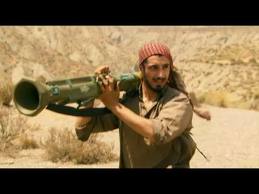
Spoiler alert/go to next paragraph: Omar, apparently not seeing the arrow pointing which way a missile launcher should aimed, tries to bring down a drone. Instead his missile goes backwards, killing terrorist leaders.
After being told they are "f.... Mr. Beans," they are sent home to continue insulting each other on who is most willing to die for Allah.
In the background it is clear that the police are catching considerable activity in their surveillance cameras, but are they after the right Muslims?
They real Jihadists do everything but take out an ad so there should be no mistakes. One of them raps: "I'm the Mujihadeen, and I'm making a scene, now you are going to feel what the boom boom means." 

Barry, the white Muslim, played by Nigel Lindsay, speaks at public forums defending Islam. "If you think we are all terrorists, why shouldn't we be?" Earlier, Barry had placed a cake with twin towers in a synagogue on the anniversary of 9/11. A speaker at one of these rallies says Muslims are misunderstood and shouldn't be feared.
The fourth lion, Faisal, played by Adeel Akhar, tries to teach crows how to fly bombs into targets.
A fifth Muslim, Hassan, played by Arsher Ali, is recruited to join them.
They argue over what they should bomb. Barry wants to bomb a mosque to inflame moderates. Omar persuades them to get disguises, put bombs under them, and blow themselves up during the London Marathon.
A suggestion that they blow up the Internet by jumping off a tree and landing ass-first on a laptop is rejected.
Spoiler alert/go to next paragraph: One lesson is brutally learned. Never try to employ the Heimlich Maneuver on someone who has a suicide bomb underneath his costume.
All five lions blow themselves up at various points, taking some police and an innocent cafe owner with them. A police sharpshooter, told to take out a man in a bear disguise, shoots a man in a "Wookie" costume instead, allowing Omar to escape for the time being. The sharpshooter insisted the man he shot was the right man by virtue of the fact that he shot him. This is caused a tautology in logic classes.
The story isn't that much unlike some real events. Najibullah Zazi, a Denver man who was preparing to blow up a train on the anniversary of 9/11 in New York City, got all the way to Manhattan without being stopped. Police had been watching him for months. Fortunately, he couldn't figure out how to make his peroxide bomb.
A security expert, defending the police reaction to the attack on the marathon in Four Lions, said, "Police shot the right man but the wrong man exploded."
One lesson, explained by Omar's boss, Matt, is that most loud bangs are not bombs, they are usually scooters backfiring.
Although the movie had a reasonably good run in the U.K. after its premiere Jan. 24 at the Sundance Film Festival, don't expect to see it at your neighborhood theater anytime soon. It might be as controversial as the concept of building a mosque near "Ground Zero." It is available on Amazon's U.K. site.
As for Morris, he has said trying to create controversy makes films boring. "I feel in a weird way that this is a good-hearted film. It's not a hate film, so I would hope that that aspect would come through."
Follow Robert Weller on Twitter: www.twitter.com/mozart99

Previously published on the Huffington Post

Tuesday, November 4, 2008

Balloon boy, Falcon Heene, found hiding in a box in the attic


screen-capture-1
Falcon Heene, age 6, pictured in the middle
A 6-year-old Fort Collins boy feared to have fallen from an experimental balloon to his likely death was hiding in his garage attic all the time.
Authorities from Larimer County to Denver had been searching for Falcon Heene since his brother reported that Falcon had climbed into a small compartment under the helium-filled balloon moments before it unexpectedly came loose from its tether at the family house and rose into the sky.
Falcon’s parents, Richard and Mayumi Heene, called police, as well as KUSA-TV 9News to ask the television station to send its helicopter in pursuit.
The balloon voyage southeast from Fort Collins was telecast live across the nation on cable news programs. Hearts broke when the balloon landed softly about 1:30 p.m. south of Denver International Airport and television coverage showed viewers that no one was aboard.
While all eyes were on the balloon chase and landing, Falcon apparently was lying low in a box in the attic above the garage. Police officers spent the day with the family and had searched the house and property when they first arrived.
The complete story of Falcon’s non-flight and why his brother said Falcon was on the balloon is expected to come out later Thursday.
Temperatures were in the upper 60s Thursday, facilitating the takeoff of a balloon never meant to carry people. It reportedly was intended to fly into storms to catch data.
If Falcon had been aboard, the balloon apparently took off so fast he would have had only 30 seconds to jump out.
The balloon traveled as much as 60 miles and as high as 3,000 feet above the more than mile-high terrain.
It looked at times like a silver mushroom or a UFO or even the spaceship that hovered over Johannesburg in the movie District 9. The situation Thursday was similar to the movie in one sense: No one had ever dealt with anything like this before.
Richard Heene, a science aficionado who chases storms, and his wife, Mayumi, appeared on the 100th episode of ABC’s Wife Swap in 2008.
Quotes from the ABC show, Wife Swap, confirm the family’s adventurous nature…
The families that have been chosen for the 100th episode swap are the storm-chasing, science-obsessed Heene family from Colorado and the psychic, performing arts-loving Silvers from Florida.
When the Heene family aren’t chasing storms, they devote their time to scientific experiments that include looking for extraterrestrials and building a research-gathering flying saucer to send into the eye of the storm. In this ultimate swap, the Heenes swap lives with a psychic mom who speaks to the dead and can control the weather, her husband and her children — who believe they are destined to be stars. This show will feature aliens, punk rockers, past-life regression and, for the first time ever, the children from the two families will face off in a kids’ table meeting. “Heene/Silver,” the 100th episode of Wife Swap, destined to become a classic!

Comments

Saturday, August 25, 2007

Army Scans Brains For War Wounds


Brain In The News

Army to Use Scans to Find Bomb Injuries

<< Back to indexAugust 25, 2007
By Daniel G. Amen M.D.   

Recently, I taught a brain-imaging continuing education seminar for physicians. One of those in attendance was an Army doctor from Fort Lewis in Washington state. He commented on the large number of brain-injured returning Iraq war vets. According to him, while the soldiers’ protective equipment is doing a good job of saving lives, the concussive injuries from the roadside bombs are causing severe trauma to the brain.
Now, the Army is beginning to embrace the same SPECT brain-imaging technology we use to help detect these wounds, many of which would have gone previously unseen or misdiagnosed in days past. Here’s a recent related story from the Associated Press…

Army to Use Scans to Find Bomb Injuries
By ROBERT WELLER
The Associated Press

FORT CARSON, Colo. -- The Army, faced with thousands of cases of brain injury from the Iraq war, will soon begin testing brain scanning equipment in hopes of finding a more accurate way to identify hard-to-diagnose wounds, the commander of the post hospital on this Colorado base said Monday.
To date, the Army has not extensively used neuroimaging equipment to detect brain injuries in returning soldiers because not enough testing has been done to judge the technology's effectiveness.
But Fort Carson will soon test a brain scan procedure that uses gamma rays along with radioisotopes, said Col. John Cho, commander of the Evans Army Community Hospital at Fort Carson. The tests will be conducted on Fort Carson units returning from Iraq, he said.
The move comes as an interagency task force, headed by Veterans Affairs Secretary Jim Nicholson, released a report Monday saying injured soldiers and veterans will get more screenings for brain injury.
It also comes after a recent study at Fort Collins found that 18 percent of troops who had been to Iraq - 2,392 of 13,400 - suffered at least some brain damage from the blasts of improvised explosive devices.
Currently, doctors often must rely on questioning soldiers to determine if they've suffered brain damage in battle. Cho said that isn't good enough; many injured show no symptoms, while other symptoms can mirror other conditions. "How do you determine that someone has actually has a traumatic brain injury other than asking the soldier?" Cho said in an interview Monday.
Such verbal tests are subject to failure for many reasons: the soldier may not remember, may deliberately withhold information to avoid being discharged, or may not yet be feeling the effects of injury.
Stephen Robinson of Veterans for America, an organization that has accused the Army of discharging soldiers with brain damage while determining they have personality disorders, was pleased with the announcement. "After two years of us complaining, they are going to do something," Robinson said.
Lt. Col. Reed Smith, head of nuclear medicine at the Evans hospital, said his staff will be receiving a new scanning camera known as a SPECT (single photo emission computerized tomography) within two weeks.
Fort Carson will use soldiers who have already been diagnosed with traumatic brain injury to test the technology and rate its effectiveness, Cho said. Results will be delivered to an Army review board.
"We feel that we that we can move forward on behalf of the Army and for soldiers faster than other places," Cho said. "Hopefully it will identify a marker that can help diagnose brain damage."
"Obviously this is potentially a very positive thing. They are taking head injuries seriously. They are looking for a technology that will detect it," said Dr. P. Stephen Macedo, a Washington, D.C.-based neurologist and former doctor with the Veterans Administration
I’m grateful to see that we’re using this technology to help our returning vets. My hope is that accurate diagnosis and effective treatment will help lessen the pain for those who’ve already sacrificed so much.
To Your Brain Health,
Daniel
Daniel Amen, M.D.
CEO, Amen Clinics, Inc.
Distinguished Fellow, American Psychiatric Association

<< Back to index

Tuesday, April 10, 2007

Sand Creek Massacre Finally Memorialized April 2007

 SAND CREEK MASSACRE NATIONAL HISTORIC SITE, Colo. - More than 142 years after a band of state militia volunteers massacred 150 sleeping Southern Cheyenne and Arapaho Indians in a misdirected act of vengeance, a memorial to the tragic event was officially dedicated Saturday.

 The Sand Creek Massacre National Historic site, located 160 miles southeast of Denver on Big Sandy Creek in Kiowa County, pays tribute to those killed in the shameful Nov. 29, 1864, attack.

 Seeking revenge for the killings of several settlers by Indians, 700 militia members slaughtered nearly everyone in the village. Most were women or children.

 Descendants of some of the victims were among several hundred people at Saturday's dedication on the rolling hills of the southeastern Colorado plains. The crowd gathered a few hundred feet from a stand of cottonwood trees along the creek that historians believe marks the site of the killings.

 After a prayer and a blessing for the troops in
 Iraq, members of the Cheyenne and Arapaho tribes chanted and played drums.

 "It's a site of shame, but it's finally being memorialized properly," said David Halaas, a former state historian.

 Eyewitness accounts of the attack include a letter from Lt. Joseph Cranmer: "A squaw ripped open and a child taken from her. Little children shot while begging for their lives."

 Tribe descendants claim they can still hear the children cry when they visit the site.

 "If there were any savages that day, it was not the Indian people," said former Sen. Ben Nighthorse Campbell, R-Colo., a member of the Northern Cheyenne tribe.

 Campbell, who sponsored the legislation making the spot a national historic site, said he slept beside the creek Friday night "to get a picture" of what the people saw before the attack.

 "I think it is the greatest testimony of the strength of a nation — that you are big enough and strong enough to acknowledge the cruelties and injuries of the past," said Patricia Limerick, chairwoman of the University of Colorado's Center of the American West and author of "Legacy of Conquest."

 The attack was recognized almost immediately as criminal. Congress condemned it and President Lincoln fired territorial Gov. John Evans.

 Witnesses told a congressional hearing that the victims were not hostile. Indian trader John S. Smith testified that the militia's leader, Col. John Chivington, knew the band at Sand Creek was peaceful and was not involved in the attacks on settlers.

 But Chivington, a Methodist minister known as "the fighting parson," was feted by Denver residents as a hero after the raid. They were terrified that the Confederacy would use Indians as their surrogates to wage war on them.

 "Among the brilliant feats of arms in Indian warfare, the recent campaign of our Colorado volunteers will stand in history with few rivals, and none to exceed it in final results," read an editorial in the Rocky Mountain News at the time.

 A Civil War memorial installed at the Colorado Capitol in 1909 listed Sand Creek as a great Union victory. But a plaque was added in 2002 giving details of the massacre to set the record straight.

 The Indians were camped at a site assigned to them by the Army. When the attack started, Southern Cheyenne Chief Black Kettle hurriedly hoisted a U.S. flag above his lodge, but to no avail. Black Kettle survived but was killed in an attack at Washita, Okla., in 1868 by soldiers led by Col. George Armstrong Custer.

 Since some of the victims of the attack were of mixed blood — the descendants of Indians and white fur traders — whites today also have a reason to revere the memorial, said Limerick.

 "There may be stories of equal anguish in our history but this is right up at the top. In a strange way, it is a basis for national pride," she said.